Skate Parks Near Me · July 10, 2026
How a Skate Park Actually Gets Built (and How to Get One Built)
Most of the parks in this directory are owned and maintained by a city or county parks department. Very few of them were the parks department's idea. The typical origin story is a handful of skaters and parents who turned up at council meetings for several years until a line appeared in a capital budget. If your town doesn't have a park, this is the process you'd be starting.
Where the money comes from
Public skate parks are usually funded from a municipal capital improvement budget, often combined with one or more of: a county or state parks grant, a private foundation grant, and money raised locally by the advocacy group itself. Local fundraising rarely covers a meaningful share of the cost, but it matters far out of proportion to its size, because it demonstrates to a council that demand is real and organized.
The cost of a park scales with its square footage and with whether it's built from poured concrete or assembled from prefabricated ramps. Councils are frequently attracted to prefab because the upfront number is smaller. Skaters almost universally prefer concrete, and the reasons are practical rather than aesthetic.
Why concrete beats prefab
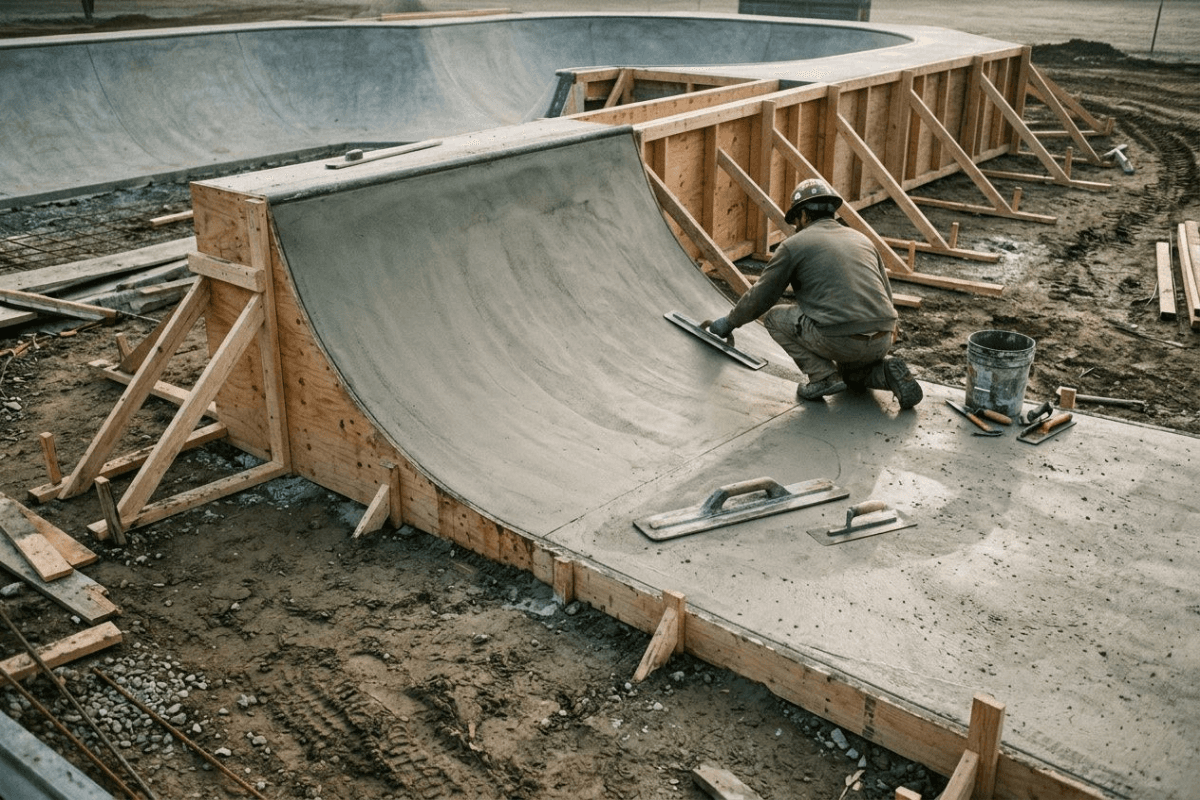
Poured concrete is shaped in place by specialist crews, many of whom skate. It is smooth, quiet, drains well, has no seams to catch a wheel, and lasts for decades with minimal upkeep. Prefabricated metal or wooden ramps are bolted onto an existing asphalt or concrete slab. They are loud enough to generate noise complaints from neighbors, they develop gaps where the ramp meets the ground, the surfaces delaminate and rust, and they need ongoing maintenance that many parks departments never budget for.
The result is a familiar pattern: a prefab park is approved because it's cheap, it degrades within a few years, skaters stop using it, and the council concludes the town didn't want a skate park after all. Advocacy groups who have been through this once tend to fight hard for concrete from the start, even if it means waiting longer.
Why it takes years
A park has to clear site selection, a design process, public comment, environmental and drainage review, procurement, and construction. Site selection is usually the longest fight, because the places that are easy to approve are the places nobody can walk to. A park hidden behind an industrial lot on the edge of town will be approved quickly and used rarely. A park in a visible, central location will attract every objection a neighborhood can produce, and it will be the one that thrives.
The objections you will hear
They are remarkably consistent from town to town: noise, crime, graffiti, liability, and the suspicion that a skate park attracts "the wrong element". The productive response is usually not to argue the point in the abstract but to organize a trip to the nearest well-designed park in a neighboring town, and let the council members see it on a Saturday afternoon with families in it.
Liability is the objection with a real answer. In most US states, public recreational facilities carry statutory protections, and skate parks are frequently addressed specifically in state law. This is a question for a municipal attorney rather than for an article, but it is a solved problem in most places, and pointing at the hundreds of city-run parks in this directory is a reasonable start.
What a good design process looks like
The parks that skaters actually use are designed with skaters in the room, by firms who specialize in skate park construction rather than by a general playground contractor. Good design accounts for skill progression: a beginner area with gentle banks that isn't in the run line of the advanced terrain, sightlines that let people watch each other, and shade and seating so a session can last more than an hour.
The features worth pushing for, in rough order of how much use they get per dollar, are a large area of good flat ground, low ledges and manual pads, banks, a mini ramp, and only then a bowl. Bowls photograph best and get used least by the beginners who make up most of a town's skaters.
If you're starting from nothing
Form a group with a name. Document demand: count the skaters you see, collect signatures, get letters from schools and youth programs. Find the one council member who is already sympathetic, because there always is one. Learn the capital budget cycle in your town and when proposals have to be submitted. And expect it to take longer than you think, because nearly every park in this directory took longer than its advocates thought.