Skate Parks Near Me · July 10, 2026
Learning to Fall: The Skill Nobody Teaches Beginners
Every skater falls. Beginners fall constantly, and the ones who progress fastest are usually not the most talented but the ones who are least afraid of the ground. That fear is reasonable and it is also trainable. Falling well is a physical skill with technique, and it can be practiced deliberately rather than learned by accident.
Bailing and falling are different things
A bail is a decision: you abandon the trick early, step off the board, and run it out or land on your feet. A fall is what happens when the decision comes too late. Almost all of the skill lies in bailing early. Committing to something halfway, then changing your mind at the last moment, is how skaters get hurt.
Practicing the bail is dull, which is why nobody does it. Ride at low speed toward a feature, and step off deliberately before reaching it. Do it twenty times. You are training your body to have an exit that isn't a panic response.
The instinct to unlearn
When you fall, your arms go out. This is hardwired and you will not override it by deciding to. A straight arm with a locked elbow taking your full weight is how wrists and collarbones break, and it is the most common serious beginner injury.
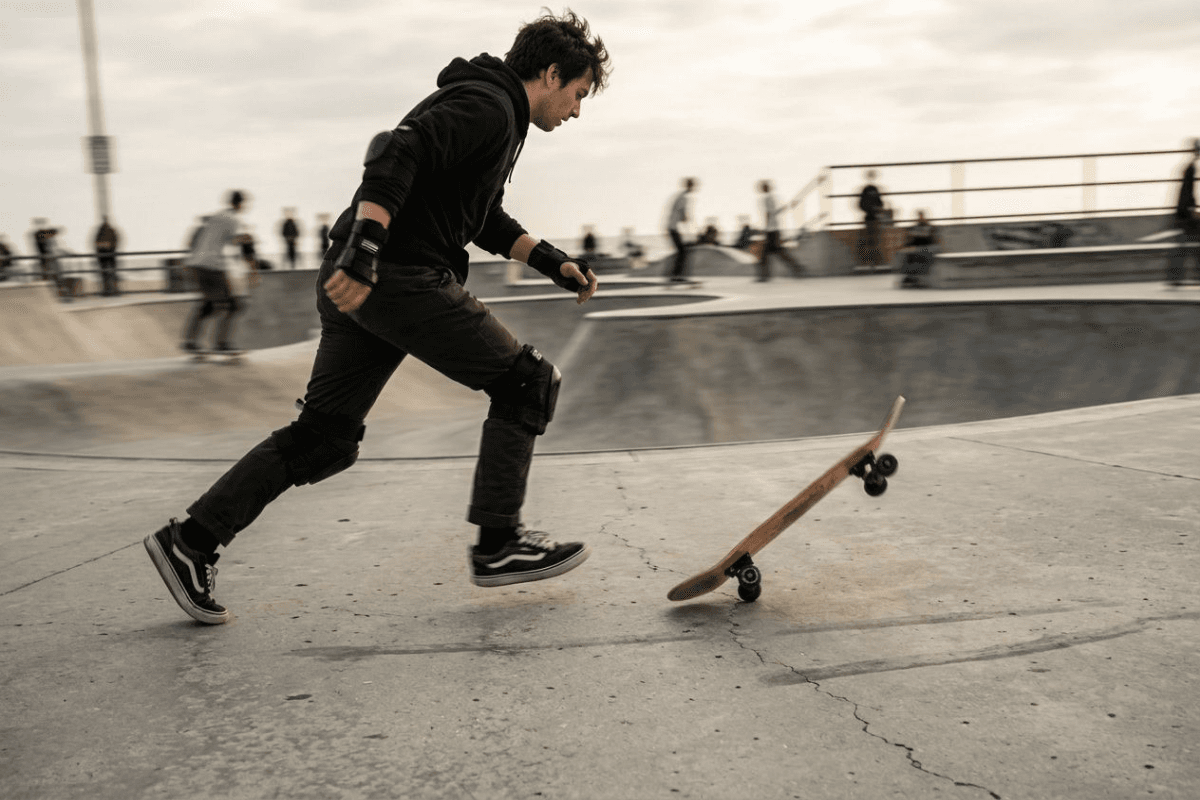
Two things help. The first is wrist guards, which take the load off the joint whether or not you got the technique right, and which are the highest-value protective gear a beginner can own. The second is training the alternative: instead of a stiff-armed catch, aim to land on the fleshy part of your forearm and shoulder and let the fall continue into a roll. Momentum you spread across a roll is momentum your wrist doesn't absorb.
Falling on transition: slide, don't catch
A bowl or ramp is the one place where the correct fall is genuinely counterintuitive. If you're going down on a curved surface, drop onto your knees and let the knee pads slide you down the transition. That's what the plastic caps on knee pads are for. Skaters call it a knee slide, and it turns what would be a tumbling fall into a controlled exit that leaves you standing at the bottom.
This is the reason knee pads matter far more in a bowl than on flat ground, and it's why transition skaters wear them long after they've stopped wearing anything else.
Falling on street: get small, get rolling
On flat ground and around ledges, the goal is to avoid landing on any single point. Tuck your chin, keep your arms in rather than out, and try to let one shoulder take the contact and carry you around. A roll dissipates the energy across your whole back instead of concentrating it in a hand, an elbow, or a hip.
The other half of a street fall is what you do immediately after: clear the run line. A skater lying in the middle of a street section is an obstacle other people are now trying to avoid at speed. Get up and move even before you check what hurts.
Speed is safety, up to a point
Beginners instinctively go too slowly. Too little speed on a ramp means you stall at the top and come back down without your wheels under you. Too little speed on a ledge means the board stops and you don't. In both cases, the fix is more commitment rather than less, which is a hard thing to believe until you've felt it. This is exactly why practicing the bail first matters: you can commit to speed once you know you can get off.
Know when to stop
Most injuries happen at the end of a session, when the legs are tired and the reactions are slow, and the skater tries the thing they've been failing at all day one last time. There is nothing to be gained from that attempt. The trick will still be there next week, and you'll land it faster with a working wrist.
If you take a knock to the head, that's the end of the session regardless of how you feel. Helmets work, and the reason to wear one is precisely that the fall you don't see coming is the one you can't fall correctly from.