Skate Parks Near Me · July 10, 2026
Skate Park Features Explained: Bowls, Banks, Ledges and Rails
Skate park vocabulary is learned by osmosis. Nobody hands you a glossary, and asking at the park feels like admitting you don't belong. Here's the vocabulary, described plainly, along with an honest note about how approachable each feature actually is.
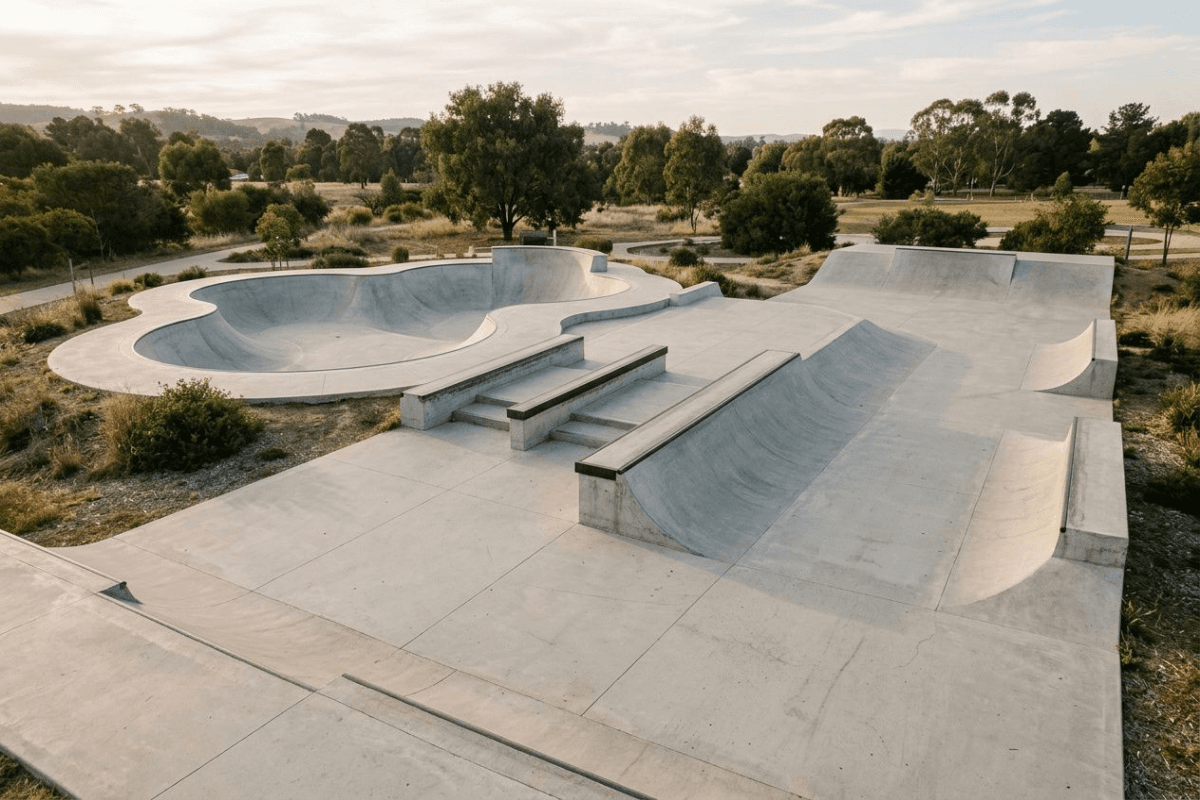
Transition features
Transition, usually shortened to "tranny", means any curved surface that takes you from horizontal to vertical. Everything in this category shares a skill: pumping, which is generating speed by shifting your weight through the curve rather than pushing with your foot.
- Bowl. An enclosed, rounded basin, often modeled on an empty swimming pool. Depth is everything: a 3-foot bowl is a reasonable place to learn to pump and carve, while a 10-foot bowl is genuinely dangerous for a beginner. Photos and reviews are the only way to tell before you arrive.
- Quarter pipe. A single curved ramp, a quarter of a circle. The standard entry point into transition. You can ride up it, come back down, and never leave the ground.
- Mini ramp. Two quarter pipes facing each other with flat ground between. Usually 3 to 4 feet tall. This is where most skaters first learn to drop in, because the consequence of a bad drop is a slide rather than a fall.
- Half pipe or vert ramp. The same shape, taller, with a vertical section at the top. This is a specialist discipline and not a place to learn.
- Spine. Two quarter pipes back to back, sharing a single coping at the top. Crossing a spine means transferring from one ramp to the other without touching down.
- Hip. Where two ramps meet at an angle, forming a corner you can carve around or launch off.
Street features
Street terrain reproduces the things skaters have always skated in cities: steps, handrails, curbs, benches. The skills transfer directly to skating outside the park, which is part of the appeal.
- Ledge. A low block with a hard edge, usually concrete with a metal or plastic strip. You grind along the edge or slide across it on the board. The most beginner-friendly grinding surface there is, because you can start with the board barely leaving the ground.
- Rail. A round or square metal bar, either flat or descending alongside stairs. Considerably harder and less forgiving than a ledge. Flat rails at ankle height exist for a reason: they're where you learn.
- Manual pad. A low, flat-topped box. You ride onto it on two wheels, in a wheelie, and ride off. Pure balance, no consequence, endlessly repeatable. The most underrated feature for a beginner.
- Bank. A flat, angled slope rather than a curve. Easier to ride than transition because there's no changing radius to read. Good for early speed and for learning to ollie up and off something.
- Stair set and gap. Exactly what they sound like. Consequence scales with size and there is no gentle version.
- Pyramid. A four-sided raised bank, often with a ledge or rail across the top. Versatile, and forgiving because you can approach it from any side and bail down a slope.
The surface matters as much as the shape
Poured concrete is smooth, fast, and lasts decades. Prefab metal or wooden ramps bolted onto asphalt are cheaper to install but louder, slower, and prone to gaps at the seams where the transition meets the ground. Those seams catch wheels. A park's surface is often the real difference between a park locals love and one they avoid, and it's the thing reviews complain about most reliably.
Where to start
If you're new, the order that tends to work is: flat ground, then banks, then manual pads and low ledges, then a mini ramp, then everything else. Notice that bowls and rails come last. They're the two features that look most like skateboarding in videos, and the two most likely to hurt you in your first month. The listings in this directory tag parks with Street section, Bowl, and Ramps badges where we can confirm them, so you can find a park that has the terrain you're actually ready for.