Skate Parks Near Me · July 10, 2026
Taking a Kid to the Skate Park for the First Time
A skate park can look like an intimidating place to bring a seven-year-old: concrete, speed, teenagers, no visible supervision. In practice it's one of the more self-regulating public spaces there is, and most of the anxiety parents bring to a first visit is solved by choosing the right hour and the right park.
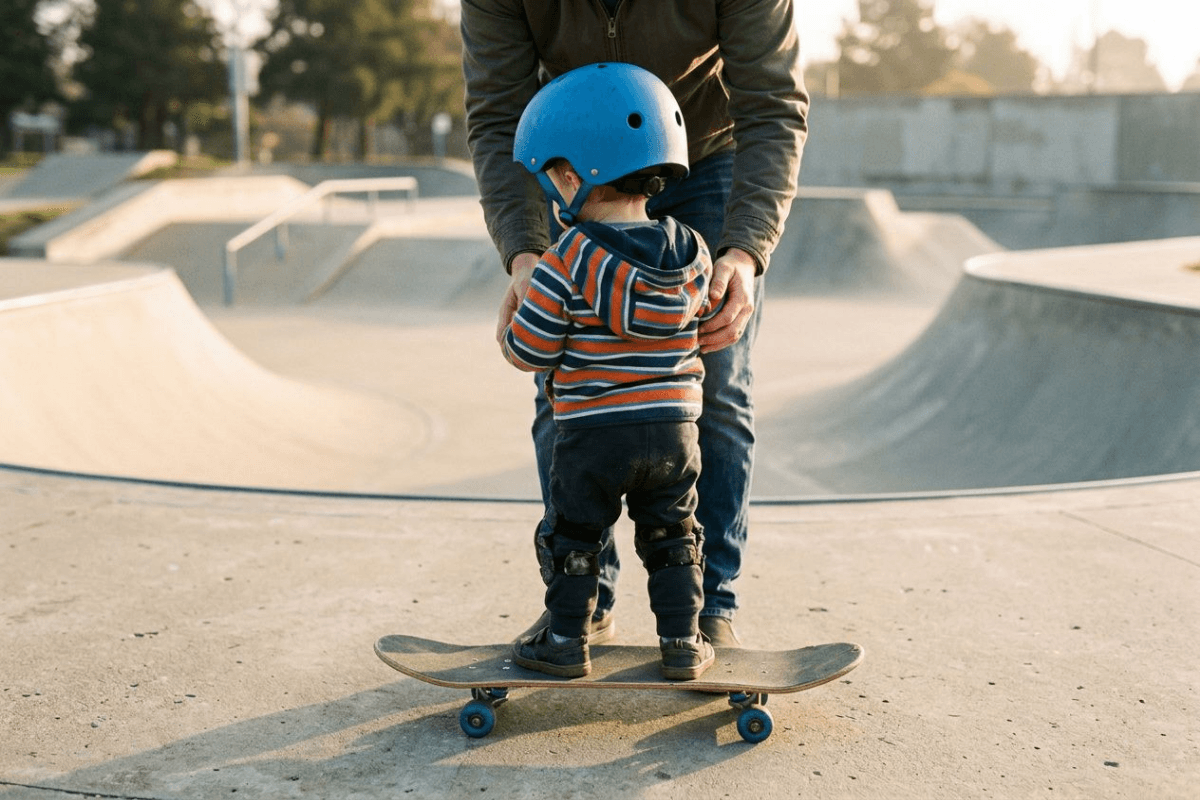
Go at the quietest possible time
Weekday mornings and early afternoons during school term are close to empty at most public parks. Weekend afternoons are the busiest. If your child is nervous, an empty park removes almost every source of stress at once: no traffic to read, no queue for a feature, no audience. It also lets them make mistakes without feeling watched, which is when children actually learn.
The corollary is that a completely empty park is a bad place for a child to skate alone, and it's a poor place to learn the social rules of a session. Once the basics are there, a moderately busy park is the better classroom.
Gear is not optional for children
Adults can make their own risk calculations. For a child learning on concrete, a helmet is the one piece of equipment with no reasonable argument against it. Many city-run parks require helmets for minors and post it at the entrance; our listings carry a Helmet required badge where visitors have confirmed the rule. Wrist guards and knee pads come next, and a child who has worn them from day one rarely objects to them later.
Fit the helmet properly: level on the head, not tipped back, with the straps forming a V under each ear and only enough slack under the chin for one finger. A helmet worn on the back of the head protects the part of the skull that never hits the ground.
Start on flat ground, away from the terrain
The first session should probably not involve any feature at all. Pushing, turning, and stepping off the board deliberately are the skills that make everything else possible, and they're best learned on a flat, empty corner of the park, or on the path outside it. Children who go straight to a bank or a bowl fall in ways that scare them, and a scared child does not come back.
Where to stand, and where not to
Stand off the concrete. It's the single most common parent mistake: standing at the edge of a bowl or in the flat middle of the street section to be near your child, without realizing you're standing in someone's run line. A skater who has to bail to avoid an adult is far more dangerous to your child than the same skater at full speed. Find a bench or a wall, and trust that the other skaters will work around a small child.
Do not sit on the ledges, the coping, or the deck of a ramp. Those are the features. This applies to parents at least as much as to skaters.
The older kids are usually the solution, not the problem
The teenagers at a skate park have an unwritten obligation to look out for the small children in it, and most of them take it seriously. Older skaters routinely stop runs, call warnings, and offer unsolicited coaching that lands better than anything a parent can say. If your child is standing in the wrong place, the correction they get from a fifteen-year-old will stick.
Where a park genuinely has a hostile crowd, the reviews say so. It's one of the things visitors write about most consistently, and it's worth reading a park's reviews before driving to it with a nervous child in the car.
Scooters, bikes, and the local rules
Many parks restrict or ban scooters and BMX bikes, and many that allow them do so only at certain hours. This is not snobbery: bikes and scooters have different speeds, turning radii, and stopping distances than boards, and mixing them takes practice to do safely. Check the park's rules before you go. We tag parks that welcome BMX where we can confirm it.
Keep the first session short
Twenty minutes of success is worth more than two hours ending in tears and a scraped elbow. Leave while it's still fun, and while your child still wants one more go. That's the feeling that gets them back into the car next weekend.